CHARLES & KWOK · MULTI-ASSET RESEARCH
The Industrial Revolution and the AI Revolution
Internal training material · Data as of October 14, 2026
In 1771, Richard Arkwright built a spinning mill on the banks of the River Derwent in Derbyshire, England. The factory was built along the river, where the water drove waterwheels, which in turn drove hundreds of spindles via shafts and belts. Workers entered the factory in shifts, performing fixed tasks at fixed times. This Cromford Mill is often regarded as the starting point of the modern factory. Before it, spinning was work done by farmers at home; after it, people had to go to where the machines were to work.
Two hundred and fifty years later, in November 2022, OpenAI released ChatGPT. Over the next three-plus years, the annual spending by several of the largest US tech companies on data centers rose from over $100 billion to over $600 billion. Companies began handing tasks like coding, research, and writing first drafts to AI, and some companies began letting AI agents take over entire workflows.
Comparing these two events is useful because the Industrial Revolution has already run its full course. We know where people at the time were mistaken: how long it took for technology to show up in productivity, how many frenzies and crashes capital went through in the middle, when workers' incomes finally caught up, and when the law began to intervene. The AI revolution is still in its early stages, and these questions have no answers yet, but the experience of the Industrial Revolution can tell us what to look for and roughly how long to wait.
Below, the Industrial Revolution is divided into three stages: the factory and steam stage of Arkwright and Watt, the railway stage starting in the 1830s, and the electrification and assembly line stage from 1880 to 1930. Each stage corresponds to a part of the AI revolution that is happening today or may happen in the future.
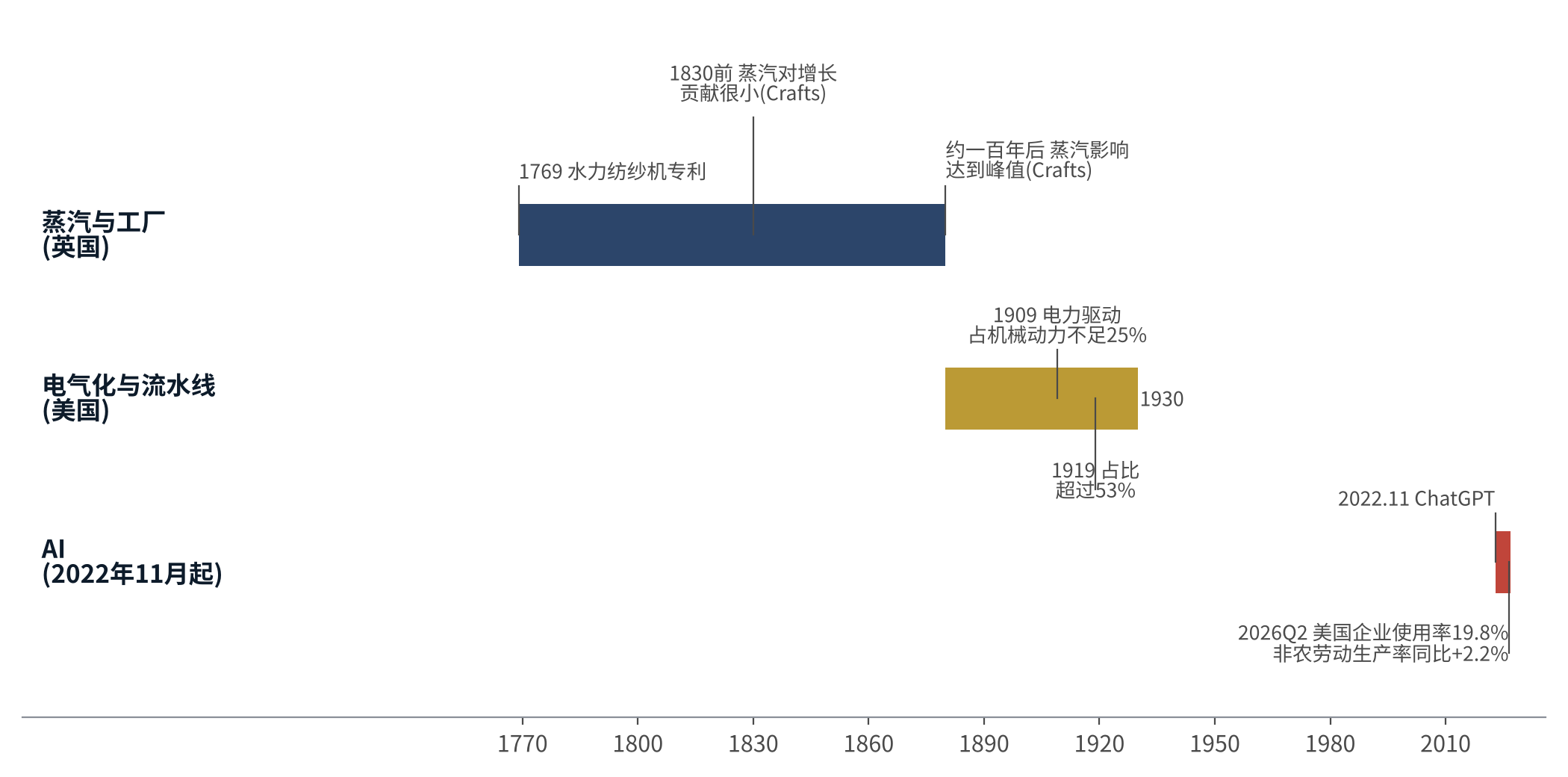
Figure 1: Timeline of the three stages of the Industrial Revolution and the AI Revolution (illustrative).
01 The machines were there, but factories had yet to change
When discussing the Industrial Revolution, many people first think of Watt's steam engine. Watt's improved steam engine was put into commercial use in 1776, but its impact on the British economy came slowly. Economic historian Nicholas Crafts calculated that steam power contributed very little to British economic growth before 1830. Its impact peaked about a hundred years after Watt's invention, and in between, one had to wait for the appearance of high-pressure steam engines around 1850. In other words, the early growth of the Industrial Revolution came mainly from factory systems like Arkwright's: concentrating machines, power, and workers together and organizing production by process. The machines themselves appeared early, but the organizational methods to use them came much later.
The story of electricity illustrates this even better. In the 1880s, US factories began using electricity. The initial approach was simple: remove the large steam engine in the factory and replace it with a large electric motor, leaving everything else unchanged. The shaft was still the same shaft, the belts were still the same belts, and the machines were still arranged around the power source. This change saved some coal but resulted in little change in productivity. The benefits of electricity only became apparent after factories switched to small electric motors for each machine: shafts and belts were removed, factories could be rearranged according to the flow of materials, workshops became brighter and cleaner, and machines could be added or removed at any time. According to Devine's research, in 1909, less than 25% of mechanical power in US manufacturing was driven by electric motors; it only exceeded 53% by 1919. From the time the first factories were electrified, this process took about forty years.
Ford's moving assembly line emerged on the basis of this rearrangement. In 1913, the Highland Park factory changed chassis assembly to an assembly line, reducing the assembly time for one chassis from 12 hours and 8 minutes to 93 minutes in 1914. The prerequisite for the assembly line was independent power at each workstation, which was impossible in the era of steam and belts. In 1990, economist Paul David compared electricity and computers, concluding that the productivity returns of general-purpose technologies only appear after enterprises redesign their factories, processes, and organizations, a gap that often spans decades.
Today, most companies use AI in a way similar to replacing a steam engine with a large electric motor back then. Employees work in their original positions, following original processes, just with an additional tool that can answer questions and help write things. The process itself hasn't changed, so the effect is limited. According to the US Census Bureau's business survey, as of May 2026, about 19.8% of US companies had used AI. Large companies use it more than small ones: 37% of companies with over 250 employees use it, while less than 20% of companies with fewer than 4 employees do. The information and financial insurance industries use it the most, approaching or exceeding one-third.
The step equivalent to "each machine having its own electric motor" in AI is redesigning processes around agents: breaking a piece of work into several segments, with each segment completed by an agent, while humans are responsible for arranging tasks, checking results, and intervening when errors occur. This step has already begun in some places. GitHub disclosed that in October 2026, about one-third of code commit requests involved AI agents, compared to less than one-tenth a year earlier. The founder of a London advertising company told CNBC that after AI took over research, first drafts, and data organization, a junior employee could now handle accounts for five clients, whereas previously it required several people.
If the experience of electricity can be applied, AI's impact on productivity will gradually manifest only after more and more companies have finished changing their processes, and changing processes is much slower than buying tools. In the coming years, it is worth watching whether the gap in usage rates between large and small companies will narrow, and whether industries other than information and finance will catch up.
02 Computing power is the new source of power
Every stage of the Industrial Revolution was constrained by where the power came from. Arkwright's factories could only be built by rivers, and production had to be reduced during dry seasons; steam engines allowed factories to leave the rivers, but they relied on coal, so factories concentrated near coal fields and canals; after the power grid appeared, factories could be built anywhere connected to the grid. The source of power determined where factories were built and how large they could be.
AI appears to be software, but its power source is very specific: chips, data centers, and electricity. In the first quarter of 2022, the combined capital expenditure of Amazon, Microsoft, Alphabet, Meta, and Oracle was $37.6 billion. By the fourth quarter of 2025, the single-quarter figure had reached $140.6 billion. The guidance for 2026 is even higher: Amazon is about $220 billion, Alphabet is close to $200 billion, and Meta is between $130 billion and $145 billion. Most of this money is used to buy GPUs and build data centers.
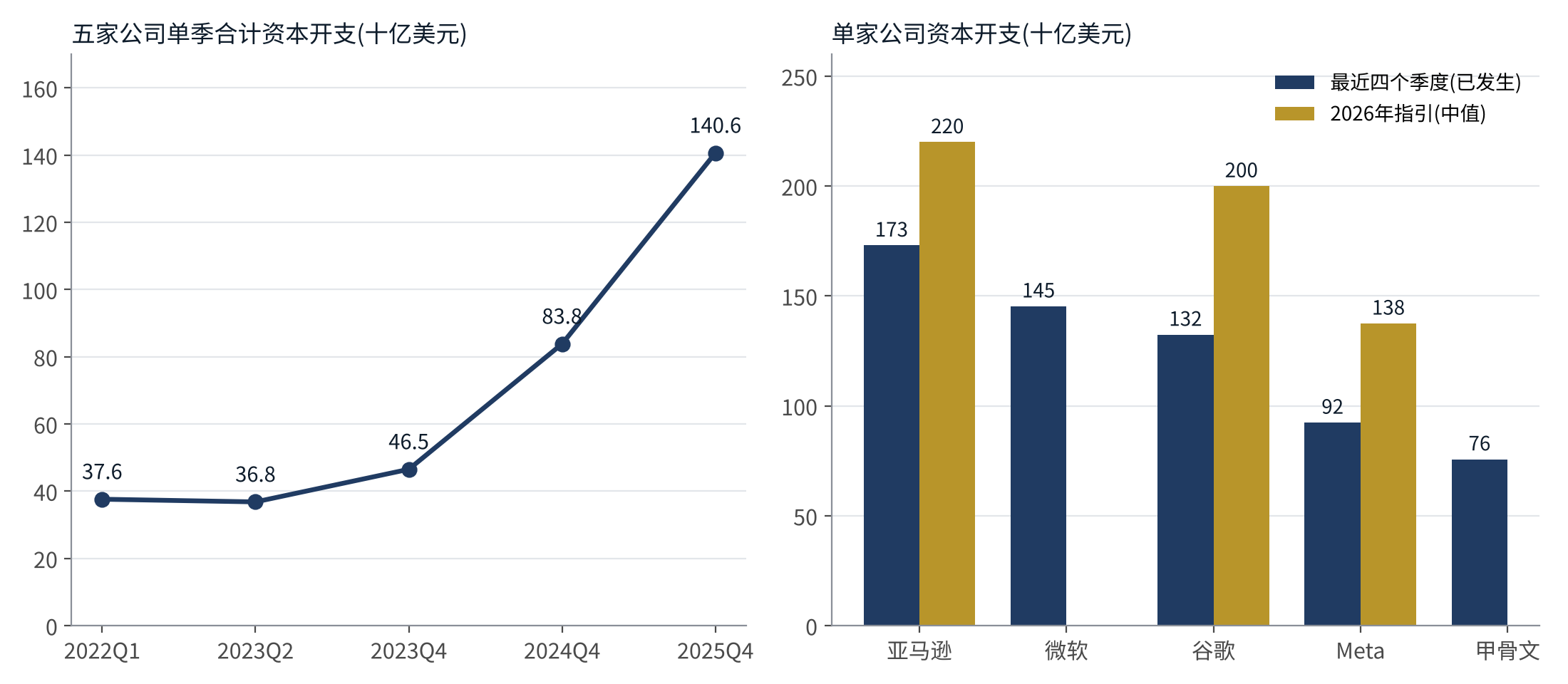
Figure 2: Capital expenditure of five hyperscale vendors. Left: combined single-quarter data; Right: cumulative values for the last four quarters for each company and full-year 2026 guidance (compiled from Epoch AI and company earnings reports, cited via media).
Data centers need electricity. The Lawrence Berkeley National Laboratory under the US Department of Energy estimates that data centers' electricity consumption in the US accounted for 4.4% of national electricity use in 2023, and could rise to 6.7% to 12% by 2028. The construction cycle for power plants and grids is measured in years, and connecting a large data center often requires waiting in line for several years. Chips are the same; TSMC's advanced packaging capacity is reportedly booked out until the end of the year. These are the "river locations" and "dry seasons" of the AI era.
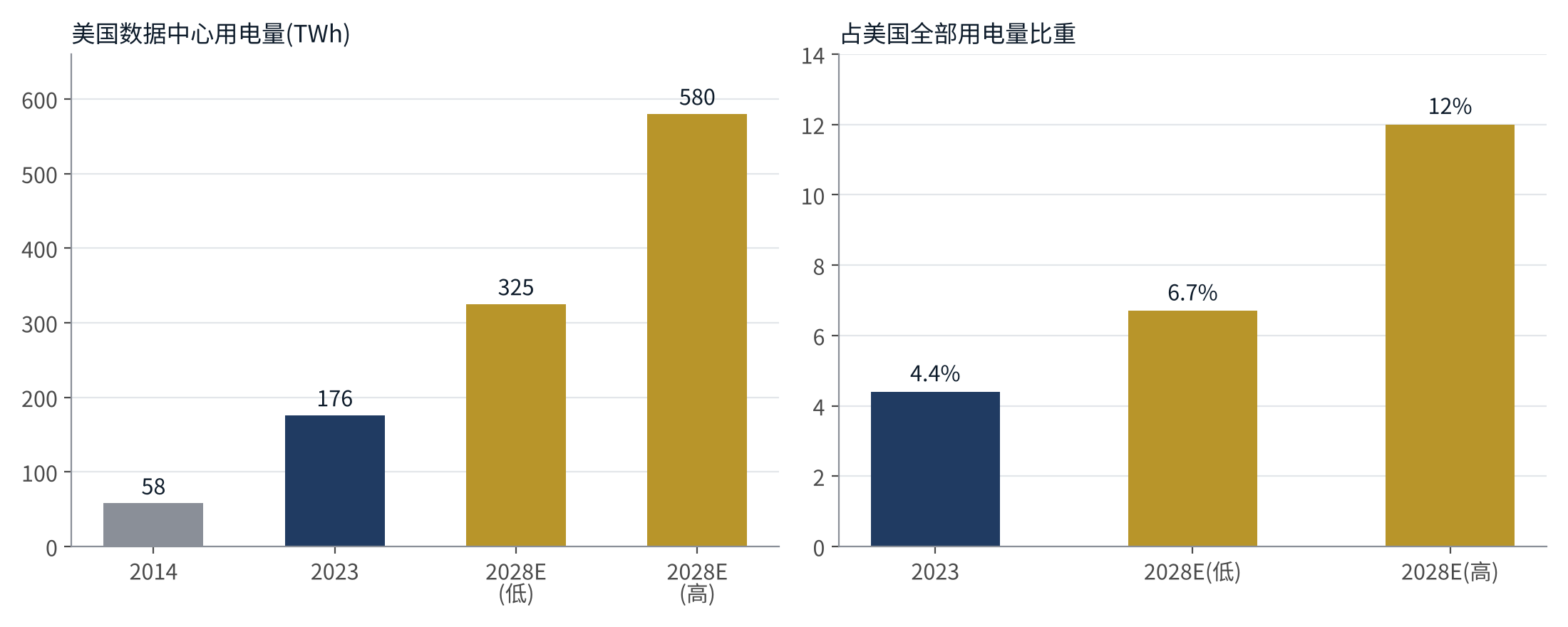
Figure 3: US data center electricity consumption and its share of national electricity use (US Department of Energy, Lawrence Berkeley National Laboratory, 2024 report).
The power grid has another characteristic: it is a network, and once a factory connects to a specific grid, it is difficult to switch. Large models are often compared to the power grid, implying that once a company builds its business on a specific model, switching also incurs costs. However, there is a major difference between models and the grid: model prices fall very rapidly (as discussed later regarding pricing, the inference price for equivalent capability drops by tens of times annually), so the economic rationale for switching to a cheaper or better model always exists. Whether a company can switch depends primarily on whether its data, workflows, and agents are held in-house or placed on the model provider's platform.
03 Waiting for productivity gains
It took about a hundred years from the invention of the steam engine to its peak impact, and about forty years from electricity entering factories to becoming the primary power source. AI has been less than four years since the release of ChatGPT. Viewed through this lens, discussing whether AI has improved productivity today is somewhat like discussing whether electricity improved productivity in 1890.
The numbers currently visible are as follows: revised data released by the US Bureau of Labor Statistics in early September shows that US nonfarm business labor productivity grew by 2.2% year-over-year in the second quarter of 2026; calculated from the start of this economic cycle in late 2019, the annual average growth is 2.1%, higher than the 1.5% of the previous cycle, but roughly in line with the long-term average since 1947. Manufacturing output in the second quarter grew at an annualized rate of 5.4%, the fastest since 2021.
How much of these figures comes from AI is currently indistinguishable. During the same period, the US economy experienced factors such as elevated inflation and investment concentrated in data center construction; the construction of data centers itself also drives output. What can be said is that, so far, productivity has not shown a clear increase exceeding historical levels. This is consistent with the early experience of electricity: the technology is in place, but the statistics have not yet caught up.
This period of waiting has the greatest impact on the market. Investors generally believe that technology will eventually yield returns, but the judgment is most likely to err on timing. The several capital frenzies of the Industrial Revolution all occurred during this period of "technology has emerged, but returns have not yet materialized."
04 Money Arrives First, Returns Arrive Later
The British railway mania of the 1840s was the earliest technology investment bubble. After the opening of the Liverpool to Manchester railway in 1830, the prospects for railways were widely viewed favorably. From 1846 to 1848, the money Britain spent annually on railway construction accounted for 5.7% to 6.7% of GDP. Railway stocks at the time were paid in installments; investors could hold shares by paying only a small portion upfront, with the remainder called in by the company as construction progressed. When stock prices rose, this method allowed many people to buy many shares with very little money; when stock prices stopped rising and call notices arrived, those who could not pay were forced to sell shares, and the selling further depressed stock prices. The railway stock index fell by about two-thirds from its high in August 1845 to 1850. Of the railway lines approved by Parliament between 1844 and 1847, about one-third were never built.
The US in 1929 represented a different kind of leverage. At that time, buying stocks required only 10% of one's own money, with the remaining 90% borrowed from brokers. The Dow Jones Industrial Average fell from its high in September 1929 to its low in July 1932, a drop of about 89%, and did not return to its 1929 high until 1954. The backdrop of this frenzy was the rapid growth of US industry in the 1920s driven by electrification and assembly lines, with cars, radios, and home appliances entering ordinary households, leading people to believe this growth would continue indefinitely. The 2000 internet bubble had a similar structure: the Nasdaq index rose by about 570% over five years, then fell by about 78% over the following two years, and most of the fiber optics laid by telecom companies were not yet utilized when the bubble burst.
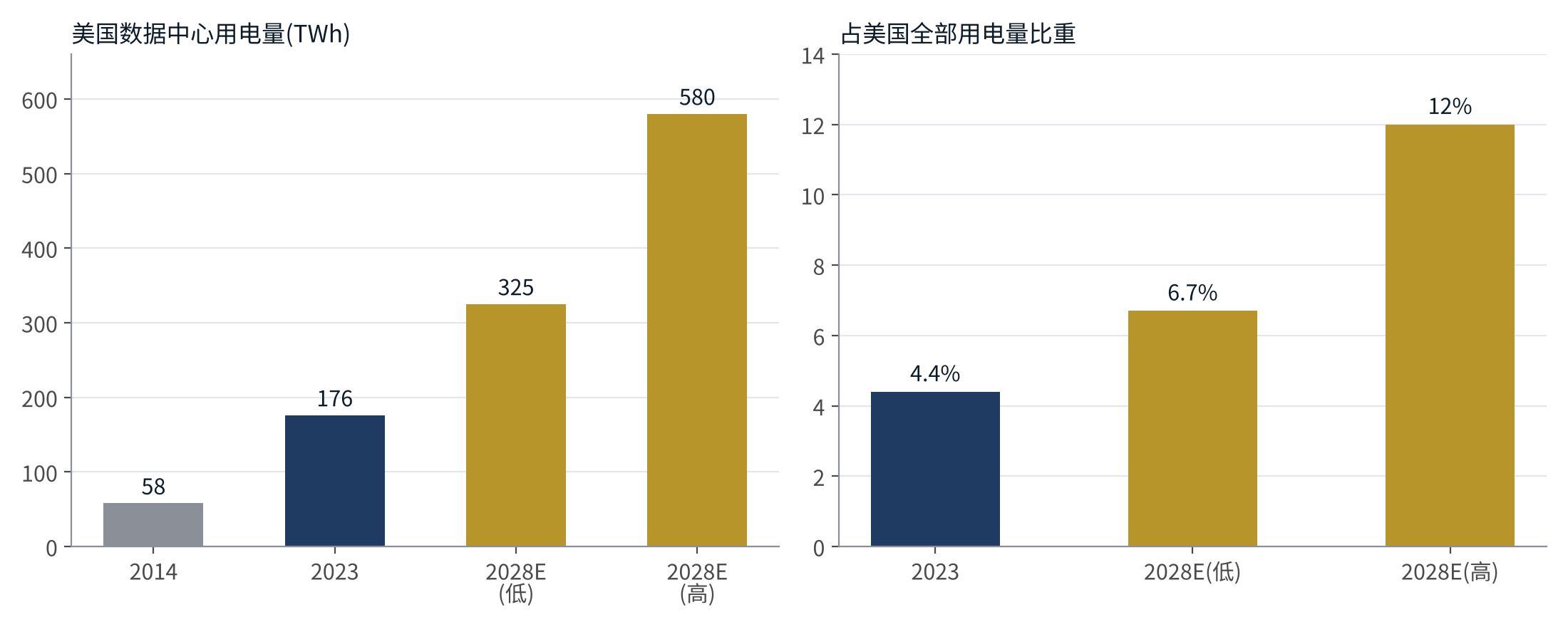
Figure 4: The decline and time to recover highs for three technology investment bubbles (compiled from historical data by Campbell and Turner, the Federal Reserve, and Nasdaq, cited via secondary sources).
These three bubbles share a common point: the bubbles burst, but the things built remain. Most of Britain's railway network today was built during that round; fiber optics were fully utilized by video and cloud computing in the late 2000s. Investors lost money, but society gained infrastructure.
The funding sources for this round of AI differ from previous ones. Amazon, Microsoft, Alphabet, and Meta primarily invest using cash generated from their operations, borrowing little, which differs from the installment payments of the railway era and the margin trading of 1929. However, leverage is increasing in other parts of the chain. Emerging cloud providers like Oracle and CoreWeave rely more on issuing debt and customer prepayments. Model companies have also signed massive long-term contracts: according to Reuters' reporting on Anthropic's prospectus, the company has committed to at least $518 billion in computing power procurement over the next ten years, with about 80% payable regardless of usage, while its 2025 revenue was approximately $4.6 billion. Alphabet reported its first quarter of negative free cash flow since going public in the second quarter of 2026. The International Monetary Fund highlighted several risks in its Global Financial Stability Report on October 13: companies are borrowing heavily to build AI, investor exposure is concentrated in a few companies, and AI companies are investing in each other and acting as each other's customers, forming cycles.
There is a view in the market that AI will repeat the rhythm of railways and electrification: a major frenzy will appear around 2028, followed by a bubble burst around 2029, because the directional judgment is correct, but returns arrive slower than expected. This prediction cannot be verified, but historical time intervals can serve as a reference:
| Event | Technology Start | Market Peak | Interval |
|---|---|---|---|
| British Railways | 1830 Liverpool to Manchester railway opened | August 1845 | ~15 years |
| Electrification and Automobiles | 1913 Ford moving assembly line | September 1929 | ~16 years |
| Internet | 1995 Nasdaq begins rising | March 2000 | ~5 years |
| AI | November 2022 ChatGPT released | Not yet occurred | — |
If a bubble occurs in this round of AI, what will remain are data centers, power plants, and the grid. Compared to railways and fiber optics, the most expensive GPUs in data centers need to be updated every few years, depreciating much faster than railway tracks, so the assets left behind have weaker value retention. Signals worth watching include: the ratio of capital expenditure to operating cash flow, the number of companies with negative free cash flow, and the size of the non-cancellable portion of computing power contracts.
05 Workers Waited Sixty Years
The most difficult aspect of the Industrial Revolution for later generations to accept was that workers' incomes did not keep up for a long time. Economic historian Robert Allen called this period the "Engels' Pause," because when Engels wrote The Condition of the Working Class in England in 1845, he was describing exactly this situation. Allen's data shows that from 1780 to 1840, UK per capita output grew by 46%, while workers' real wages grew by only 12%, profit rates doubled, the share of national income going to profits rose, and the share going to labor fell.
During the same period, textile artisans displaced by machines fell into hardship, and workers in the Luddite movement smashed looms. People at the time generally believed that machines would make workers increasingly poor. Later developments showed that this situation lasted for decades but did not persist indefinitely: from 1840 to 1900, per capita output grew by 90%, real wages grew by 123%, and wages caught up. Allen's explanation is that new technologies require large amounts of capital when they first emerge; capital is scarce, so profits are high; high profits are reinvested into new factories and machines, and only after capital has accumulated sufficiently do workers' bargaining power recover and wages catch up with productivity. Counting from 1780, this process took about sixty years.
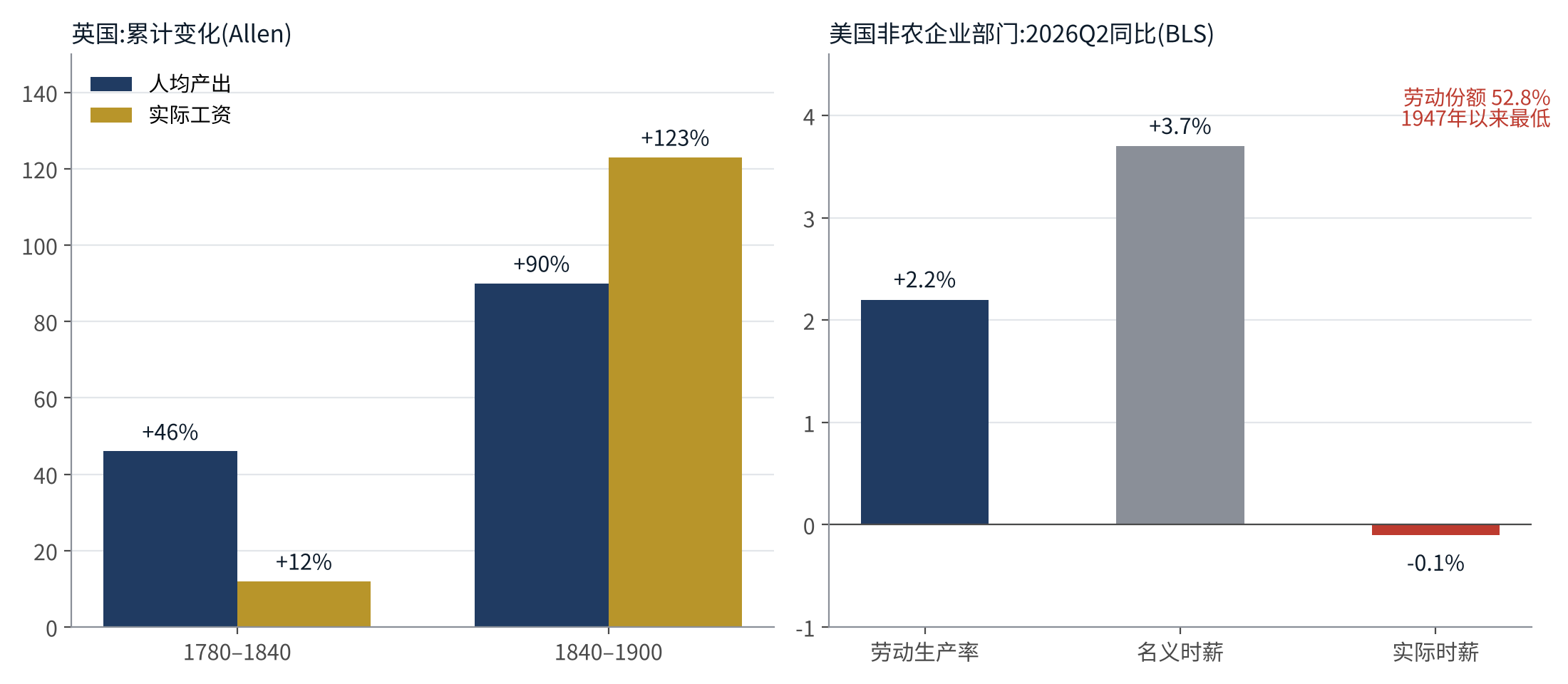
Figure 5: Left: Cumulative growth in per capita output and real wages in the UK during two periods (Allen, 2009). Right: Year-over-year data for the US nonfarm business sector in the second quarter of 2026 (US Bureau of Labor Statistics).
The US data for 2026 has similarities with this history. In the second quarter, the labor share in the US nonfarm business sector fell to 52.8%, the lowest since this statistic began in 1947. Productivity grew by 2.2% year-over-year, real hourly wages after adjusting for inflation fell by 0.1% over the past four quarters, and unit profits for nonfinancial corporations rose by 17.8%. Output is growing, but a larger portion of the growth is flowing to profits.
These figures cannot all be attributed to AI; inflation is high this year, and real wages are already under pressure. But the direction is consistent with the UK from 1780 to 1840. Changes at the job level are more direct: according to Indeed data, hiring for US software development roles has increased since February 2025, but 70% of the new roles are senior positions; a Stanford University study shows that employment for software developers aged 22 to 25 has fallen by nearly 20%; in a survey of 1,500 business leaders by the Open University in the UK, 19% stated they have reduced hiring of junior employees, with over 40% of them attributing the reason to AI. During the Industrial Revolution, those impacted were artisans; this time, those impacted are newly entering knowledge workers.
The lesson from the Industrial Revolution is that labor eventually shares in the gains from growth, but only after sufficient capital accumulation and the emergence of new jobs; in the intervening decades, an entire generation bore the cost of the transition. Whether the AI era can shorten this period depends on how quickly new jobs appear and whether people can promptly shift to roles involving planning, judgment, and verification. What is worth monitoring continuously is whether the labor share can recover from 52.8%, whether the gap between real wages and productivity is narrowing or widening, and the hiring ratio for entry-level positions.
06 Things That Became Cheaper
Another long-term outcome of the Industrial Revolution was that goods previously affordable only to the wealthy became accessible to everyone. The Ford Model T is the most typical example. In 1909, the Model T Touring sold for $850; after the assembly line went into production, the price fell steadily, reaching just $290 by 1925. In 1914, Ford also raised workers' daily wages to $5, enabling his own workers to afford the cars they built. Moving from selling to a few wealthy individuals to selling to millions of ordinary families was the commercial significance of the assembly line.
AI prices have fallen much faster than the Model T. Research firm Epoch AI tracked six benchmarks and found that the median annual decline in inference prices to achieve the same capability level was 50 times. Another estimate suggests that achieving the capability level of GPT-3 in 2021 saw the price per million tokens drop from $60 to $0.06 by the end of 2024, a decline of about 1,000 times in three years. The Model T took sixteen years to drop by about two-thirds, while AI prices for equivalent capabilities dropped to one-thousandth in three years.
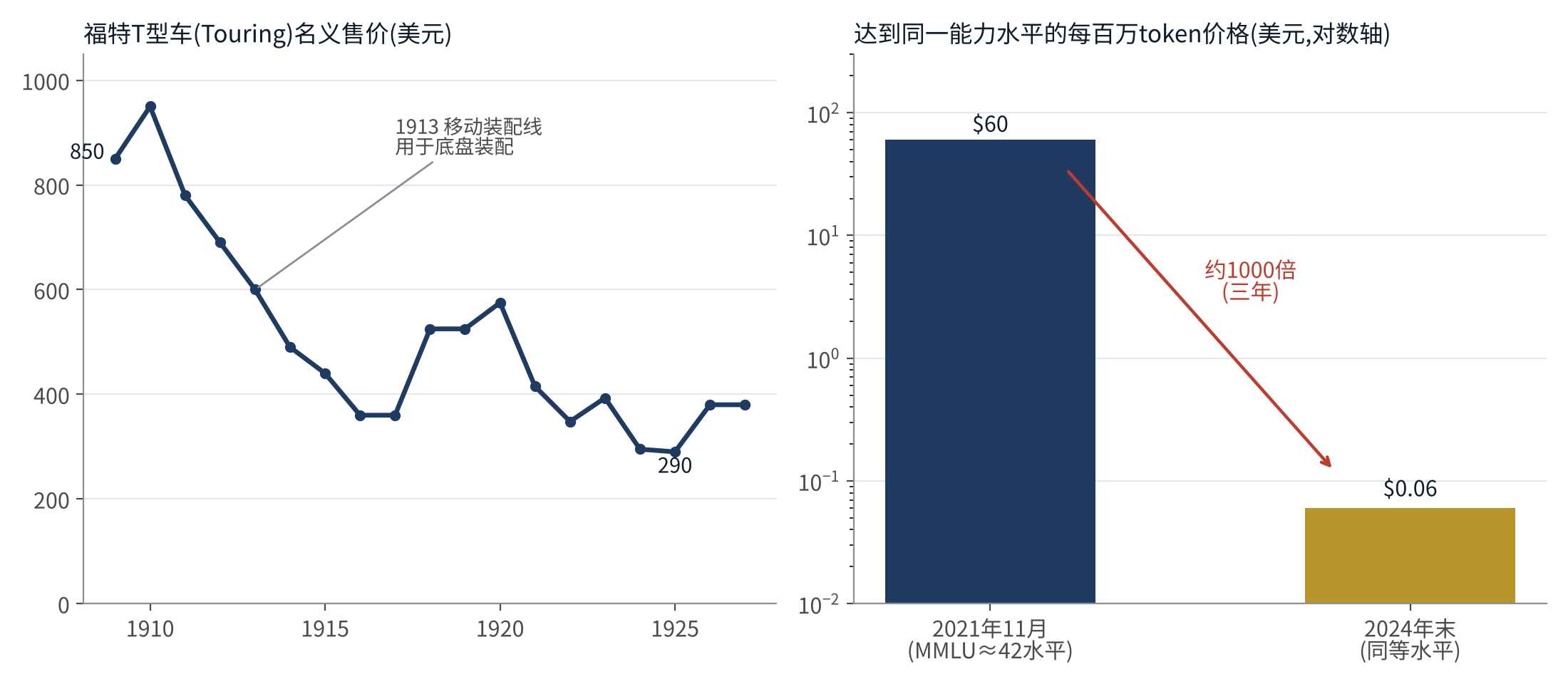
Figure 6: Left: Price of the Ford Model T Touring. Right: Price per million tokens to achieve the same capability level (right chart uses a logarithmic scale).
The Industrial Revolution lowered the prices of physical goods, while AI lowers the prices of services. Expert services such as healthcare, law, education, and financial consulting were previously mainly accessible to the wealthy. Health is an intuitive example: research by Chetty et al. published in JAMA showed that from 2001 to 2014, the life expectancy of men in the top 5% of US income increased by 2.34 years, while for men in the bottom 5% it increased by only 0.32 years. If AI combined with wearable devices can provide ordinary people with health management close to that of a family doctor, this gap has the potential to narrow. China's State Council's 2025 "Opinions on Deeply Implementing the 'AI+' Action" (Guo Fa [2025] No. 11) also outlines this direction: "Explore and promote high-level resident health assistants accessible to all, orderly promote the application of artificial intelligence in scenarios such as assisted diagnosis, health management, and medical insurance services, and significantly improve the capacity and efficiency of primary healthcare services."
After prices fall, whether they are used effectively is another matter. The Model T became cheap, but it also required roads, gas stations, and people who knew how to drive. AI is the same: currently, large enterprises use it more than small businesses, and the price difference between high-end and low-end models still spans several orders of magnitude. Whether the most capable tier will also become cheap like the Model T will determine how far "service equality" can go.
07 Who Controls the Power
Electricity had a characteristic in the Industrial Revolution: it primarily brought production capacity to factories, while bringing mainly consumption to households. Electric lights, fans, and refrigerators greatly facilitated family life, but ordinary people had few opportunities to use electricity for production or entrepreneurship; production remained concentrated in factories and companies.
The Internet era had a similar situation. Individuals could go online, but users and data were locked within the respective systems of a few large platforms; shopping, payments, social networking, and advertising were all completed within the platforms, which did not interoperate. Some call this "digital feudalism."
Whether AI will make capabilities more centralized or more decentralized currently shows signs of both. The centralizing side is obvious: in the last four quarters, seven companies invested a combined $657.1 billion in data centers, with the four largest accounting for $543.1 billion; only a few companies can produce top-tier large models, and model companies' computing power depends on these cloud providers. The decentralizing side is that individuals can now call upon near-expert-level capabilities at very low cost; one person plus a few agents can complete the work of a small team from the past.
Whether individuals can own their own agents, using them to compare prices across platforms, handle tasks, and switch models, depends on two things: first, whether platforms are willing to open interfaces to third-party agents, and second, whether mobile phone and operating system manufacturers can keep their promise not to sell user data. Embedding large models into mobile operating systems may bypass the entry points of super-apps, or it may make operating system manufacturers new gatekeepers. The paths in China and the US are also different. The US developed from personal computers and fixed internet, accumulating a large amount of text and content, with generative AI breaking through first in content generation; China's mobile internet is more developed, with a large amount of behavioral data accumulated on phones. Guo Fa [2025] No. 11 proposes that by 2027, the penetration rate of new-generation smart terminals and agents will exceed 70%, and by 2030, it will exceed 90%.
08 How Long It Took for Law to Catch Up
After the Industrial Revolution began, it took Britain a long time to start regulating factories with law. Arkwright's factory was built in 1771, and Britain's first factory law with actual enforcement mechanisms was the 1833 Factory Act (Labour of Children, etc., in Factories Act 1833), a gap of 62 years. This law prohibited textile mills from employing children under 9; children aged 9 to 12 could work no more than 8 hours a day, and those aged 13 to 17 no more than 12 hours; children under 13 had to receive 2 hours of schooling daily; and factory inspectors were established to check compliance. The 1844 Factory Act further limited children's working hours to 6.5 hours a day, with 3 hours of education, and limited adolescents aged 13 to 18 and women to a maximum of 12 hours a day.
Financial rules came even later. The 1844 British Railway Act did not limit railway companies' dividends and allowed companies to omit depreciation of fixed assets in their accounts, making dividends appear high and further driving up stock prices. The US did not pass Regulation T until 1934, setting minimum margin requirements for buying stocks, initially at 25% to 45%, and fixed at 50% after 1974.
This time with AI, the law came much faster. Article 5 of the EU Artificial Intelligence Act, effective from February 2, 2025, prohibits eight practices: (a) manipulative or deceptive techniques causing significant harm; (b) exploiting vulnerabilities due to age, disability, or socioeconomic situation; (c) social scoring leading to unreasonable disadvantage; (d) predicting criminal behavior based solely on profiling or personality traits; (e) indiscriminate scraping of facial images to build facial recognition databases; (f) emotion recognition in workplaces and schools, except for medical and safety purposes; (g) inferring sensitive characteristics such as race, political opinions, or sexual orientation via biometrics; (h) real-time remote biometric identification in public spaces by law enforcement, with only very narrow exceptions. From December 2, 2026, an additional prohibition will be added against generating non-consensual private images and child sexual abuse material. Article 99 specifies fines: violations of Article 5 carry a maximum fine of €35 million or 7% of global annual turnover, whichever is higher; violations of other obligations carry a maximum of €15 million or 3%; providing incorrect or misleading information to competent authorities carries a maximum of €7.5 million or 1%.
China's Guo Fa [2025] No. 11 addresses employment issues in the "AI+ Livelihood and Well-being" section: "Strengthen employment risk assessments for AI applications, guide innovation resources toward directions with high job creation potential, and reduce the impact on employment." The same section also states: "Strongly support AI skills training to stimulate AI innovation, entrepreneurship, and re-employment vitality."
From the release of ChatGPT to the effective date of EU Article 5, only two years and two months passed, a stark contrast to the 62 years for the Factory Act. However, the two regulate different things. The Factory Act regulated labor itself—working hours, age, and education; current AI laws mainly regulate which uses are prohibited, and handling employment impacts remains at the level of assessment and training. In finance, the International Monetary Fund has issued risk warnings, but there are currently no specific rules targeting AI investment leverage, which resembles the situation during the 1844 Railway Act.
09 Viewing the Two Revolutions Together
Looking back, the most underestimated aspect of the Industrial Revolution was time. The steam engine's impact peaked a century after its invention; electricity became the primary power source in factories forty years after its introduction; workers' wages caught up with productivity sixty years later; and laws began regulating factories sixty years later. At every stage, technology moved much faster than societal adjustment. AI is clearly faster in the speed of technological diffusion, with faster price declines and faster legal follow-up, but enterprise process restructuring, capital recovery of investments, and worker job transitions still require time and are unlikely to keep pace with technology.
Another underestimated aspect is the rhythm of capital. Several bubbles in the Industrial Revolution occurred during the period when technology was proven but returns had not yet materialized; the bursting of bubbles did not mean technological failure, as railways and electricity continued to expand after the bubbles. This round of AI investment is larger and more concentrated, with a higher proportion of operating cash flow in funding sources, and leverage primarily residing in long-term contracts of emerging cloud providers and model companies.
The two revolutions also have clear differences. The Industrial Revolution amplified physical strength and material production, while AI amplifies cognition and knowledge work; the Industrial Revolution impacted artisans, while AI impacts newly entering white-collar workers; each additional unit of Industrial Revolution products consumed raw materials and labor, whereas the cost of each additional AI answer is rapidly approaching zero, with only electricity and chips as hard constraints.
If one wishes to continuously track this comparison, several sets of data are useful: quarterly productivity and labor share from the US Bureau of Labor Statistics (Q3 initial values released on November 5); bi-weekly updates on enterprise AI usage from the Census Bureau; quarterly capital expenditures and operating cash flows from several large companies; the proportion of data center electricity consumption; and enforcement cases under Articles 5 and 99 of the EU Artificial Intelligence Act.
Note: Some data in the text come from media reports and secondary compilations (including aggregated capital expenditures of hyperscale vendors, content from Anthropic's prospectus, content from International Monetary Fund reports, index data and job data from several bubbles), and have not been individually verified against original disclosures; the bubble timeline for 2028 to 2029 is a market forecast, used only as a reference in the text. Main sources: US Bureau of Labor Statistics, US Bureau of Economic Analysis, US Census Bureau, US Department of Energy and Lawrence Berkeley National Laboratory; Crafts (2004), Devine (1983), David (1990), Allen (2009), Chetty et al. (2016); Epoch AI; EU Artificial Intelligence Act; Guo Fa [2025] No. 11; UK parliamentary records.
Watch the project
Watch on YouTubeWorking on something similar?
Bring your setup, your goal and the detail you are stuck on.
Discuss the project